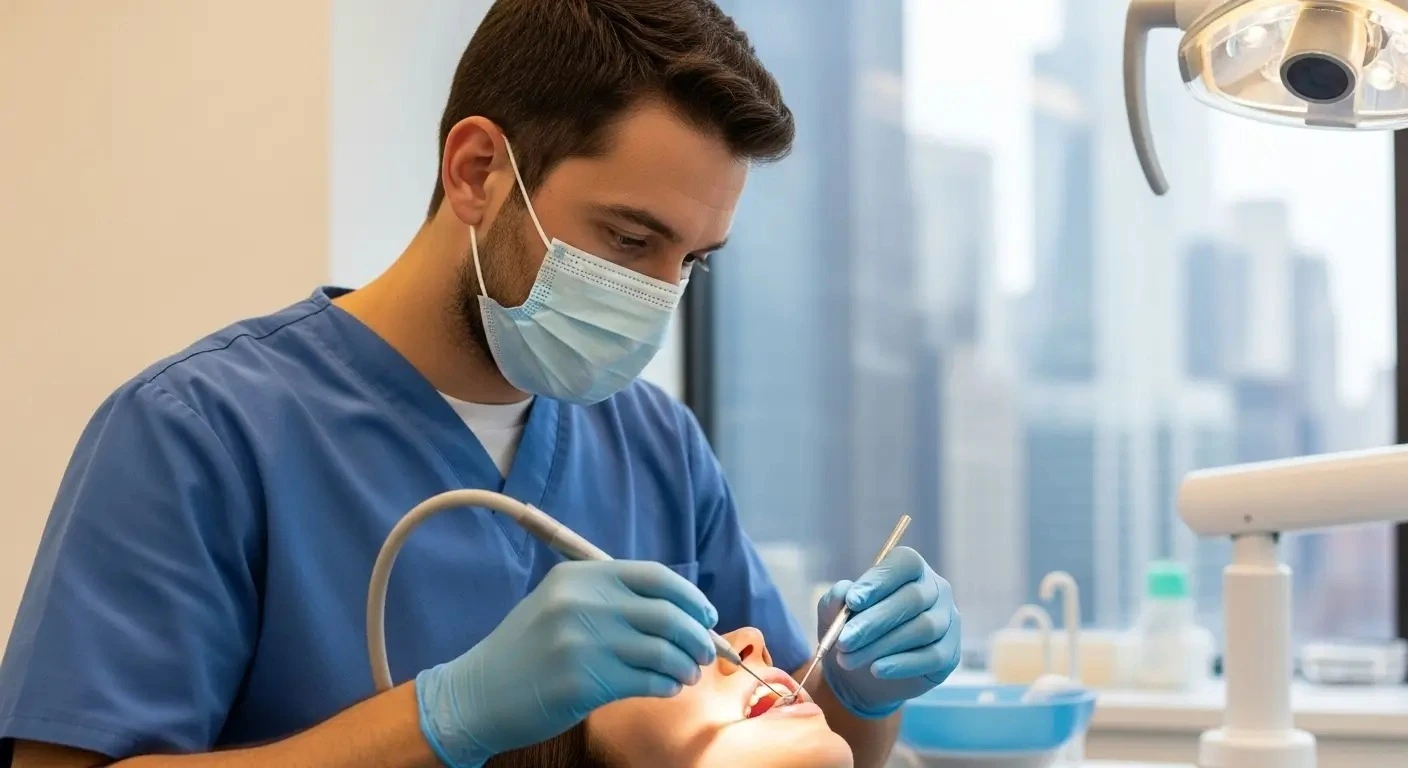
Pick a Brooklyn dentist with multilingual staff and easy building access, and half the battle of bringing an elderly parent in is already won. The tooth pain is the easy part. The fear underneath it is what actually keeps people away.
If you’re the adult child handling this for a Russian, Ukrainian, or German-speaking parent, you know the drill already. Someone has to explain “periodontitis” (advanced gum disease) in a way your mom actually trusts. Someone has to understand why she flinches at a drill sound that reminds her of dentistry from a different country and a different decade.
We hear versions of this story constantly at Trump Village Dental on Coney Island Ave. Here’s what genuinely helps.
An elderly parent’s mouth isn’t the same as yours
Drier saliva. Thinner gums. Old dental work finally catching up all at once. Treatment plans have to account for all three, not just whichever tooth is hurting this week.
Dry mouth is usually the biggest surprise for families. It’s frequently a side effect of blood pressure medication, diabetes drugs, or antidepressants, and it’s a common cause of dry mouth in older adults, alongside dehydration, and it strips away the saliva that normally protects teeth from decay and infection, according to NIDCR’s guidance on oral health in older adults. A parent who went their whole life without a cavity can suddenly get three at once in their 70s. That’s not neglect. That’s the medication list.
Gum recession tells a similar story, just slower. Decades of brushing, some grinding at night, an old filling finally cracking at the edge. None of it happened overnight, so nobody should expect it to get fixed in one visit either.
Your parent will hear the diagnosis in their own language
We have staff who speak Russian, Ukrainian, and German directly with patients. Not a phone interpreter on speaker. Not you translating on the fly between two languages you’re only half fluent in yourself.
Here’s why that one detail matters more than almost anything else on this list: a patient who understands “we need to remove this tooth before the infection spreads to the jaw” tends to agree and move forward. A patient who gets a garbled half-translation, or none at all, usually just nods, smiles politely, and never books the follow-up. We’ve watched that exact pattern repeats for years across Brighton Beach and Sheepshead Bay. It’s probably the single biggest reason elderly immigrants wait until something becomes an emergency.
You don’t have to sit there and interpret every sentence yourself. Here’s how dental care in your parent’s language works at our office.
What tends to show up after decades without steady dental care
Loose dentures. Untreated gum disease. Missing back teeth that were pulled years ago because extraction was the only affordable option at the time. We see this constantly, and it’s rarely one isolated problem. It’s usually three or four things that stacked up quietly.
A denture made 18 years ago, for instance, often no longer fits, simply because the jawbone underneath has shrunk with age. Patients describe it as “still sort of working,” which is a low bar nobody should have to accept for something they wear every day.
Old metal fillings crack at the edges eventually too, sometimes fillings placed in another country’s dental system decades ago. None of this reflects poorly on the patient. It reflects what happens when consistent dental access simply wasn’t there for long stretches of someone’s life. Almost all of it is fixable now, usually with fewer visits than families expect walking in.
Dentures or implants: how that decision actually gets made
If several teeth are failing or already gone, the real question becomes dentures versus dental implants, and the answer depends on jawbone health, budget, and how strongly your parent wants something that doesn’t come out at night.
Traditional dentures cost less and work fine for a lot of seniors. Implants, a titanium post that fuses to the jawbone and replaces the missing tooth’s root, cost more upfront but often eliminate the slipping and clicking that make eating in front of grandchildren embarrassing. We walk families through this trade-off often enough that it rarely takes more than one visit to land on an answer, and we handle both the consultation and the procedure under one roof.
You can look over the dental implant page and the dentures page beforehand, just so your parent isn’t hearing the vocabulary for the first time in the chair.
Insurance, Medicare, and what actually gets covered
Original Medicare doesn’t cover routine dental work. That surprises almost every family the first time they hear it. What often does help: Medicare Advantage plans, Medicaid managed care, and PPO insurance, all of which we accept, along with CareCredit for anything left over out of pocket.
| Coverage type | What it usually covers | What to check beforehand |
|---|---|---|
| Original Medicare | Little to no routine dental | Ask if your parent carries a supplement |
| Medicare Advantage | Cleanings, sometimes dentures or extractions | Benefits differ a lot plan to plan, call ahead |
| Medicaid managed care | Basic care, sometimes restorative work | Bring the plan card to the first visit |
| PPO insurance | Cleanings, fillings, partial implant coverage | We verify this before any treatment starts |
| CareCredit | Monthly payments on out-of-pocket costs | Interest-free promos available on approval |
We check benefits before your parent sits down, not after. That one step alone removes most of the financial anxiety families walk in with. If you’re still sorting out what your parent’s plan actually covers, we’ve broken down how dental insurance works in Brooklyn in plain language.
Getting ready for the first visit
Bring insurance cards. Bring a medication list, including anything over the counter. Show up 15 minutes early so paperwork doesn’t eat into the actual appointment.
If mobility is a factor, say so when booking. Our office sits on Floor 2 with elevator access, and it helps our front desk plan the visit around it rather than figuring it out in the waiting room.
A couple other things worth doing ahead of time: ask specifically for a Russian, Ukrainian, or German-speaking staff member when you call, and if your parent gets anxious sitting still for long stretches, mention that too so we can keep the first visit shorter. If old dentures are being replaced, bring them along, or even just a photo. It helps us match the bite correctly. If your parent speaks Ukrainian, here’s what dental care in Ukrainian looks like at our office.
Most families expect the first visit to be longer and more intense than it actually is. In practice, it’s mostly conversation and a gentle exam. The full treatment plan almost never gets crammed into that first 20 minutes. If a missing tooth comes up during the visit, it’s worth asking whether dental implants are safe for seniors over 60.
Book the First Visit
We’re open every day except Saturday, including Sunday, which tends to be the one day working adult children actually have free for something like this. Contact us or take a look at our About Us page to see the multilingual team your parent will actually be sitting across from.
Frequently Asked Questions
Yes. Our team communicates directly with patients in Russian, Ukrainian, and German, so elderly parents hear their diagnosis and options from someone they understand, not through a rushed interpreter.
Yes, we’re open Sunday through Friday, 10 AM to 6 PM, closed Saturday, which gives working family members a day off to bring a parent in without missing a shift.
Yes. Ill-fitting dentures are common after years of jawbone changes, and we assess fit and chewing function to decide whether a reline or a full replacement makes more sense.
Often, yes. PPO, Medicare Advantage, and Medicaid managed care plans frequently cover part of a first visit, and we verify your parent’s specific benefits before any treatment begins.