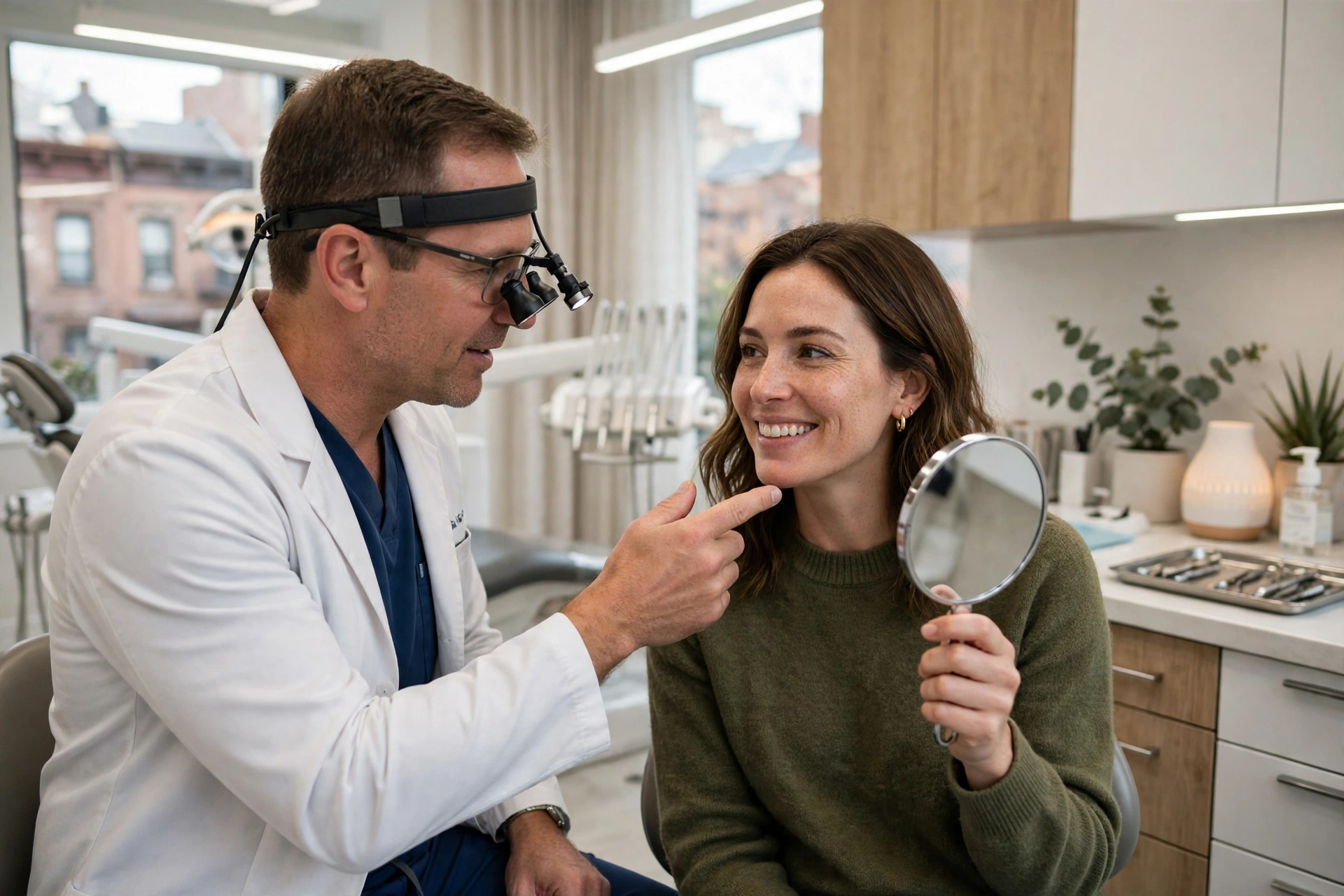
Yes. In New York, a dentist can use Botox for dental health problems such as jaw tension from grinding. Botox used only for looks is not part of dentistry.
At a glance
- Allowed: Botox tied to dental health, such as grinding, jaw disorders, and facial pain.
- Not allowed: Botox used only for cosmetic reasons.
- Status: The FDA has not approved Botox for dental uses, so dentists use it off-label.
- Evidence: NIDCR says researchers lack conclusive evidence that Botox helps jaw disorders.
- First step: An exam, simple care, and a custom night guard when it fits.
You can get Botox at a dermatologist’s office, a med spa, and in some cases a dentist’s chair. That last one surprises people. It raises a fair question: is a dentist even allowed to do it?
The short answer is yes, with limits. In New York, those limits tie Botox to dental health. This guide explains what a dentist can treat, what the research says, and what to ask before you agree to anything.
At Trump Village Dental on Coney Island Ave, we start with a consultation and an exam. The legal and medical facts below come from New York State law, the National Institute of Dental and Craniofacial Research (NIDCR), the American Dental Association (ADA), and MLMIC, a New York dental liability insurer.
Can a dentist give Botox in New York?
Yes, when the treatment relates to restoring and maintaining dental health. New York’s law defines dentistry around the oral and maxillofacial area, meaning the mouth, jaws, and related facial structures.
The law defines dentistry as diagnosing and treating pain, injury, deformity, or physical conditions of that area when the work relates to restoring and maintaining dental health. You can read the wording in Section 6601 of the New York Education Law.
MLMIC describes a written opinion from the New York State Board of Dentistry on Botox, in MLMIC’s legal summary. The Board said the law does not prohibit a licensed dentist from using Botox in that area when it relates to dental health. The dentist must be competent to do it. Using Botox solely for cosmetic purposes, or beyond a dentist’s competence, can count as professional misconduct.
One more fact matters to patients. The FDA has not approved Botox for specific dental uses, so dentists use it off-label. Off-label means the drug is used in a way the FDA has not specifically approved. That is why you should expect a clear explanation of side effects before you agree.
What does a dentist treat with Botox?
As part of a dental treatment plan, dentists can use Botox for jaw and facial problems, including teeth grinding, jaw joint disorders, facial pain, and trouble adjusting to new dentures.
Botox is a brand of botulinum toxin type A. It temporarily relaxes the muscle it is injected into. Dentists use that effect on muscles that clench, ache, or move unevenly. MLMIC lists these accepted uses within a restorative or maintenance-related dental plan:
| Accepted dental use | What it means |
|---|---|
| Bruxism | Grinding or clenching your teeth |
| Temporomandibular disorders (TMD) | Pain and dysfunction in the jaw joint and the muscles that move your jaw |
| Orofacial myofunctional disorders | Problems with how the muscles of the mouth, face, and tongue work |
| Sialorrhea | Excessive drooling |
| Facial pain and trigeminal neuralgia | Pain along the facial nerves |
| Oral and maxillofacial trauma | Injury to the mouth, jaws, or face |
| Adjusting to new dentures | Muscles that move unevenly while you learn to wear new dentures |
MLMIC notes there is no exclusive list of accepted uses. So ask your dentist to name the dental problem the treatment targets.
At our Brooklyn office, our page on Botox treatments at our Brooklyn office names jaw discomfort as one of the dental-related concerns we address.
How does Botox work on the jaw muscles?
Botox blocks the nerve signal that tells a muscle to contract, so the muscle relaxes for a limited time. That effect is temporary, so Botox is one option, not a cure.
The target is the chewing muscles. A 2026 scoping review explains the mechanism: Botox inhibits the release of acetylcholine, the chemical that carries the contraction signal from nerve to muscle. That lowers how hard the muscle can contract for a time.
The same review says researchers have mainly studied Botox for persistent jaw muscle pain, particularly when conservative therapies did not give enough relief. That order matters. Botox is studied as a later step, not a first move.
What does the research say about Botox for jaw problems?
The research is not settled. The National Institute of Dental and Craniofacial Research says researchers do not have conclusive evidence that Botox injections into chewing muscles help with jaw disorders.
NIDCR lays out TMD care in steps in NIDCR’s TMD treatment summary. Simple steps come first: soft foods, heat or cold on the face, jaw stretching and strengthening exercises, short-term over-the-counter pain relievers, and self-management. Intermediate steps come next if those do not help, such as intraoral appliances and physical therapy.
The wider research points the same way. A 2024 systematic review and meta-analysis in PLOS ONE reported that research on Botox for jaw disorders has not yet produced definitive conclusions, and that studies show conflicting results on pain.
NIDCR also warns about permanent changes to your bite. It says placing crowns, grinding down teeth, and orthodontic treatments do not help TMDs and can make the problem worse.
What this means for you: Botox is an option your dentist can discuss. It is not a guaranteed fix. A dentist who promises results is promising more than the research supports.
Is a night guard or Botox better for teeth grinding?
A custom night guard is the common first step for teeth grinding, because it shields your teeth while you sleep. Botox acts on the muscles and does not replace a guard.
Grinding is common. A 2021 survey by the ADA’s Health Policy Institute found more than 70% of dentists noticed signs of grinding and clenching in their patients, according to the ADA’s MouthHealthy guide to teeth grinding. Most people do not know they grind. Signs include chipped or cracked teeth, worn edges, jaw tenderness, dull headaches, ear pain, and neck pain.
The ADA lists stress, sleep disorders, and teeth that do not line up properly among the causes. A dentist looks for the cause first, because the ADA stresses getting at the root of the habit.
Shift work adds fatigue and clenching to the mix. See how grinding cracks teeth on night shifts for what that looks like in practice.
If you also snore or wake up tired, tell us. The ADA says a sleep study can measure what happens while you sleep, and our team offers sleep apnea treatment in Brooklyn for patients who need it.
Is Botox at the dentist safe, and what should you ask?
Botox has side effects, and its use in dentistry is off-label. Ask who performs it, what training they have, and whether it ties to a dental problem you actually have.
Bring these questions to any dentist who offers Botox:
- Who will give the injections, and what Botox training do they have?
- What dental problem is this treating, and what simpler options did we try first?
- What are the side effects, including any that could be permanent?
- Is this off-label, and what does that mean for me?
- Does the plan include a night guard or other care?
A good answer to every question is specific and plain. Be wary of any promise of guaranteed results. MLMIC flags guarantees and success claims as an advertising risk for dentists, and the research does not support them.
Who is a good candidate for dental Botox?
Candidates have jaw tension, grinding, or facial pain that a dentist has examined and linked to muscle activity. Simpler care comes first, and your medication list matters.
A good conversation starts with symptoms: jaw soreness when you wake up, clicking, headaches, chipped teeth, or worn edges. We look for a dental cause first.
Cosmetic-only goals are a different case. MLMIC reports that New York dentists cannot use Botox solely as a cosmetic treatment. If smoothing lines is your only goal, ask a dermatologist or another licensed medical provider.
Share every medication, supplement, and health condition at your consultation. Your dentist, and your doctor when needed, decide whether Botox is safe for you.
Should you see a dentist or a dermatologist for Botox?
See a dentist for jaw tension, grinding, or facial pain tied to your teeth and bite. See a dermatologist or other medical provider when smoother skin is your only goal.
| Your goal | Who to see | Why |
|---|---|---|
| Jaw tension, grinding, or facial pain tied to your teeth | A dentist | Dentists can use Botox when it relates to dental health, and they can examine your teeth and bite |
| Smoother skin or forehead lines only | A dermatologist or other licensed medical provider | New York dentists cannot use Botox solely as a cosmetic treatment |
| Both goals | Each provider for their own goal | Tell every provider about every other treatment you have |
Who holds the needle matters too. MLMIC’s Botox case study notes that New York law lets licensed medical professionals, such as registered nurses and licensed practical nurses, inject Botox under the supervision of a physician or dentist. Unlicensed individuals cannot inject it, even with supervision. Ask for the injector’s name and license type before you book.
What happens at a Botox consultation at our Brooklyn office?
We start with a consultation to decide whether Botox is the right option for your needs and goals. It begins with a complete oral exam and digital X-rays.
- The exam. You get a full exam of your teeth and gums and digital X-rays. We look for worn enamel, cracks, and signs of grinding.
- The conversation. We ask about jaw pain, headaches, sleep, and what you have already tried, such as a night guard.
- The options. We explain what we found in plain English and lay out your options with real costs attached. We cover side effects and the off-label status of Botox before you decide. You make the call.
- The plan. If Botox fits, it becomes one part of a dental plan. Any cracked or worn teeth get treated as part of that plan.
Does insurance cover Botox at the dentist?
Plans differ, and Botox is off-label in dentistry, so ask your plan before you book. We verify your benefits for free before you come in.
We accept most PPO plans and Medicaid, and we also take CareCredit. Call +1 718-946-8585 with your insurance information, and we tell you what you will owe before your appointment.
Want to know what to ask your insurer? Read which questions to ask your insurer before you call.
Book Your Botox Consultation
Tell us what you are feeling, and we will tell you straight whether Botox fits. Contact us to pick a time, or learn more about Botox at Trump Village Dental first. This guide is general information, not medical advice.
Frequently Asked Questions
Yes. In New York, a dentist can use Botox when it relates to restoring and maintaining dental health, such as jaw tension, grinding, or facial pain. Cosmetic-only use falls outside dentistry.
As part of a dental treatment plan, dentists can use Botox for teeth grinding, jaw joint disorders, facial pain, and muscle trouble adjusting to new dentures.
Research is mixed. NIDCR says researchers lack conclusive evidence that Botox helps jaw disorders, so simple care and a custom night guard come first. Ask whether it fits your case.
A custom night guard is the common first step for teeth grinding, because it shields your teeth while you sleep. Botox acts on the muscles and does not replace a guard.
Botox has side effects, and its use in dentistry is off-label. Ask who performs it, what training they have, and what side effects to expect before you agree.
In New York, a dentist cannot use Botox solely for cosmetic purposes. Botox for forehead or smile lines on its own belongs with a dermatologist or other medical provider.
Plans differ, and Botox is off-label in dentistry, so ask your plan before you book. We verify your benefits for free before you come in.